

Quick Answer: Medicare often denies mobility scooter claims in Florida because medical necessity is not clearly documented, paperwork is incomplete or incorrect, or the request does not meet Medicare’s strict coverage rules, especially the in-home use requirement. You have the right to appeal, and with the right documents from your doctor and supplier, many people are able to get decisions reconsidered.
If you’re turning 65 or already on Medicare in Florida, it’s easy to feel overwhelmed when a mobility scooter claim gets denied. You may worry you chose the wrong Medicare option or missed some confusing rule in the fine print. This article explains in plain language why these denials happen and what you can realistically do next.
We’ll cover the most common reasons Medicare denies mobility scooter claims, how the appeal process works, and simple steps to lower your chances of another denial. No complicated insurance jargon here, just clear, step-by-step guidance you can use right away.
If Medicare Denied Your Mobility Scooter Claim, You Are Not Alone
Many people who are brand new to Medicare, as well as long-time beneficiaries, are surprised when a scooter claim is turned down, even when their doctor said they needed it.
A denial is frustrating, but it is not the end of the road. You have the legal right to ask Medicare to look at your case again. Once you understand the most common mobility scooter denial reasons and how the appeal process works, the situation feels far less scary and much more manageable.
Why Does Medicare Deny Mobility Scooter Claims?
Medicare has specific rules for mobility scooters and other kinds of Durable Medical Equipment (DME). Understanding these rules is the key to avoiding simple mistakes that can cost you time and money.
In Florida, Medicare scooter coverage usually falls under Medicare Part B (medical insurance) for medically necessary DME. Whether you have Original Medicare or a Medicare Advantage plan, the basic idea is the same: the scooter must be medically necessary and used primarily in your home.
Below are three of the most common reasons Medicare denies mobility scooter claims.
Medical Necessity Is Not Clearly Demonstrated
One of the biggest reasons Medicare denies mobility scooter claims is that medical necessity is not clearly shown in your records.
Medicare wants proof that:
- You have a health condition that seriously limits your mobility.
- You cannot safely use a cane, walker, or manual wheelchair inside your home.
- A mobility scooter (also called a power-operated vehicle) will help you perform daily activities in your home, such as getting to the bathroom, kitchen, or bedroom.
This is what Medicare means by medical necessity and functional need.
Your doctor’s role is critical. They must:
- Document your specific diagnosis and mobility limitations.
- Explain that you cannot safely use less powerful equipment.
- Show how a scooter will reasonably improve your ability to move around inside your home.
If your doctor’s chart notes are short, vague, or focus mainly on outdoor use, for example, “patient would like a scooter for shopping and going to the park,” Medicare may deny the claim. They are looking for detailed, in-home mobility limitations, not just convenience or comfort.
Q: My doctor said I “could use” a scooter. Is that enough?
Usually not. Medicare wants very clear documentation that you need the scooter to function safely in your home, and that other options are not enough.
Incomplete or Incorrect Paperwork
Another frequent reason for a denied mobility scooter claim is simple paperwork problems. Even if you clearly meet medical necessity, errors in forms can stop Medicare from approving the claim.
Common paperwork issues include:
- Missing or incomplete doctor’s order
- Wrong or missing DME billing codes
- Missing signatures or dates
- Supplier claims submitted before the required face-to-face exam with your doctor
- Outdated or inconsistent medical notes that do not match the scooter request
Medicare relies on clean, accurate paperwork to process DME claims. If something is missing or does not line up, the claim may be denied automatically, often with a short explanation that does not fully describe what went wrong.
A Medicare-knowledgeable DME supplier can be very helpful here. Many Florida beneficiaries find it helpful to ask their scooter supplier to carefully review all documentation before submitting anything to Medicare.
Not Meeting Medicare’s Coverage Requirements
Even with good paperwork, you must still meet Medicare’s specific coverage requirements for mobility scooters.
Key Medicare eligibility requirements for scooters usually include:
- A documented mobility limitation that significantly impairs your ability to perform activities of daily living (ADLs) in your home
- Inability to safely use a cane, walker, or manual wheelchair to meet those in-home needs
- Physical and cognitive ability to operate the scooter safely
- A home environment that allows safe use, with enough space to move and turn
- A Medicare-approved doctor who has evaluated you and written a prescription for the scooter
One of the most misunderstood rules: Medicare focuses on use inside your home, not just outdoors. If records suggest the scooter is mainly for long distances outside, visiting friends, shopping, or travel, Medicare may consider it not medically necessary.
This is where people in Florida often get confused. You might think, “I can walk short distances in my home, but I can’t walk far enough to get through a big grocery store, so I need a scooter.” That makes sense from your perspective, but Medicare’s rules prioritize in-home function first.
Q: Does Medicare cover a scooter just because I have arthritis and pain?
Not automatically. Your records must show that your arthritis or other condition makes it very hard to safely move around inside your home and that a scooter is the most appropriate equipment for that need.
If you’re unsure how Part B generally works for medical equipment and out-of-pocket limits, you may find it helpful to read more about Medicare costs and coverage caps. Even though that page focuses on medications, it can give you a sense of how Medicare thinks about coverage and spending limits.
How to Appeal a Denied Medicare Scooter Claim
Appealing a denied Medicare scooter claim can feel like too much paperwork at first, especially if you already felt overwhelmed just enrolling in Medicare. But the appeal process is a series of steps, and you do not have to do everything at once.
You have the right to appeal any Medicare denial. Many Florida beneficiaries who calmly follow the steps and work closely with their doctor find that their case gets a more favorable second look.
Understanding the Five Levels of Medicare Appeal
Before walking through each step, it helps to know the full picture. Medicare offers up to five levels of appeal. Most people resolve their case at Level 1 or Level 2, but knowing the path ahead makes the process feel less uncertain.
| Level | Name | Who Reviews It | Deadline to File |
|---|---|---|---|
| 1 | Redetermination | Medicare contractor | 120 days from MSN date |
| 2 | Reconsideration | Qualified Independent Contractor (QIC) | 180 days from Level 1 decision |
| 3 | ALJ Hearing | Administrative Law Judge (OMHA) | 60 days; $180+ in dispute required |
| 4 | Medicare Appeals Council | Departmental Appeals Board | 60 days from ALJ decision |
| 5 | Federal District Court | Federal judge | 60 days; $1,870+ in dispute required |
Note: If you have a Medicare Advantage plan, your first step is an internal appeal with your plan rather than the Medicare Redetermination process. Your plan’s denial letter will list the specific deadline that applies, which is often shorter than the 120 days under Original Medicare.
Step 1: Review Your Denial Letter
Your first step is to carefully read your denial notice. For Original Medicare, this is usually listed on your Medicare Summary Notice (MSN). If you have a Medicare Advantage plan, you will receive a separate denial letter from your plan.
Look for:
- The specific reason code and explanation for denial
- Any mention of “not medically necessary,” “insufficient documentation,” or “not primarily used in the home”
- A list of any documents Medicare says were missing
Write down or highlight the denial reason. Your appeal strategy should directly address that reason. For example:
- If the letter says “not medically necessary,” you may need stronger documentation from your doctor.
- If it mentions “missing documentation” or “incorrect coding,” your supplier and doctor may need to correct forms or add missing information.
Q: What if the language in the denial letter is confusing?
That’s common. You can call 1-800-MEDICARE or your plan’s member services line and ask them to explain the reason in simpler terms. You can also bring the letter to a local Medicare advisor in Florida for help understanding it.
Step 2: Gather Supporting Documents
Next, gather all the documents that support your case. This is especially important when medical necessity was not clearly shown the first time.
Helpful documents can include:
- A detailed letter of medical necessity from your doctor
- Office visit notes that describe your mobility limitations
- Physical therapy or specialist reports that show your difficulty walking
- Any fall history or safety concerns inside your home
- An updated prescription for a mobility scooter, with specifics
A strong letter of medical necessity should:
- Mention your diagnosis and how long you’ve had it.
- Describe your pain, weakness, balance problems, or other mobility issues.
- Explain why a cane, walker, or manual wheelchair is not enough in your home.
- Show how a scooter will allow you to safely perform daily activities such as bathing, dressing, toileting, and meal preparation inside your home.
If Medicare forms feel overwhelming, consider asking a trusted family member to help you organize these documents. Many Florida residents also work with a local Medicare information service that can walk them through what to ask their doctor for, without any sales pressure.
Step 3: File Your Appeal
To appeal a denied Medicare scooter claim, you generally must:
- File the appeal within 120 days of the date on your denial notice or MSN (for Original Medicare Level 1).
- Use Medicare’s Redetermination Request Form for Original Medicare, or your plan’s appeal form for Medicare Advantage.
- Attach copies, not originals, of your supporting documents.
Key tips:
- State clearly why you disagree: “I am appealing because…” followed by a short explanation.
- Attach your doctor’s new or expanded letter, plus any additional records.
- Keep copies of everything you send, along with proof of mailing. Certified mail is recommended.
If Medicare paperwork in general feels unfamiliar, this step-by-step Medicare paperwork guide can help you get comfortable with the format, even though it focuses on enrollment rather than appeals.
Q: Where do I send my appeal?
The address is listed on your Medicare Summary Notice or plan denial letter. Always use the address they give you, and send by certified mail so you have proof it was received.
Step 4: Follow Up on Your Appeal
After you send your appeal, Medicare or your Medicare Advantage plan will review your case. During this time:
- Keep all letters you receive in one folder.
- Answer any requests for more information as soon as possible.
- Call the number on your denial letter if you are unsure what they are asking for.
If your Level 1 appeal (Redetermination) is denied, your denial letter will explain your next option and the deadline to escalate to Level 2. Each level gives you another opportunity to present your case with additional documentation.
If Medicare coverage questions keep coming up for you beyond just this scooter issue, Medicare coverage problem help in Tampa and Florida explains common coverage challenges and how people address them.
Tips to Avoid Mobility Scooter Claim Denials
While no one can promise Medicare will approve every claim, there are simple steps you and your doctor can take to reduce the chance of a denial before you ever submit.
Many people in Florida wish they had known these tips before their scooter claim was filed. If you’re still in the planning stage, or preparing for an appeal and possible resubmission, these suggestions can help.
Ensure All Paperwork Is Complete and Accurate
Before your DME supplier submits anything to Medicare, ask them directly:
- Have you checked all the forms for errors?
- Are the billing codes correct for a mobility scooter?
- Is the date of my face-to-face exam with my doctor included?
- Is my doctor enrolled with Medicare?
You and your supplier should confirm that:
- Your doctor is Medicare-approved and has a current NPI (National Provider Identifier).
- The supplier is enrolled with Medicare and accepts Medicare assignment.
- All required forms are filled out, signed, and dated correctly.
A quick double-check before submitting can prevent simple mistakes that cause unnecessary delays or denials.
Get a Clear Prescription and Letter of Medical Necessity
Your doctor’s prescription and letter of medical necessity are your strongest tools in avoiding denials. Ask your doctor’s office to be as specific as possible.
A strong prescription and letter should include:
- Your diagnosis, for example, severe osteoarthritis, neuropathy, or stroke after-effects
- How the condition limits your ability to walk inside your home
- Why you cannot safely use a cane, walker, or manual wheelchair
- A clear statement: “A mobility scooter is medically necessary for this patient to safely perform activities of daily living in the home”
- Any recent falls or near-falls related to your mobility issue
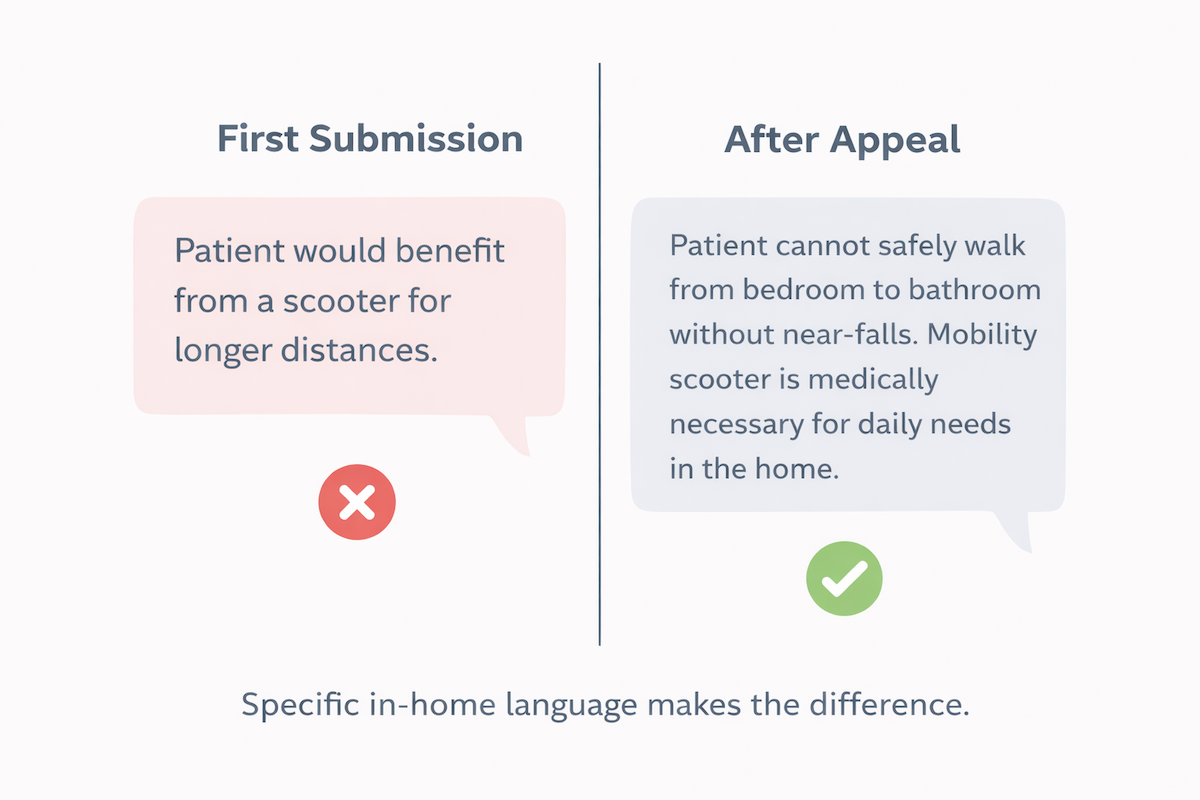
To show how much wording matters, consider this scenario: Maria, age 67 in Florida, can walk a few steps with a cane but becomes very unsteady after that. Her doctor’s first note said, “Patient would benefit from a scooter for longer distances.” Medicare denied the claim. On appeal, her doctor updated the note to say, “Patient cannot safely walk the distance from bedroom to bathroom without near-falls and severe pain. A mobility scooter is medically necessary for safe toileting and daily needs in the home.” That single change in language was enough to get the claim reconsidered.
Work With a Trusted DME Supplier
Not all equipment suppliers have the same level of experience with Medicare claims. A supplier who regularly works with Medicare beneficiaries in Florida will usually know what documentation Medicare expects.
When choosing a supplier, you might ask:
- How often do you work with Medicare mobility scooter claims?
- Will you review my doctor’s notes and letter before submitting?
- Can you tell me if anything seems missing or unclear?
If you’re also reviewing your Medicare Advantage options in Florida, how to choose a Medicare Advantage plan can help you understand how plan networks and DME rules may affect scooter coverage.
Get the expert support that you need!
Frequently Asked Questions
How much does Medicare pay for a mobility scooter?
If Medicare approves your mobility scooter claim, Medicare Part B typically covers 80 percent of the Medicare-approved amount. You are responsible for the remaining 20 percent after you have met your Part B deductible, which is $257 in 2025.
If you have a Medicare Supplement (Medigap) plan, it may cover some or all of your 20 percent share, depending on the plan type. If you have a Medicare Advantage plan, your cost sharing follows your plan’s DME benefits, which can differ from Original Medicare. Check your plan’s Summary of Benefits or call member services to confirm what you will owe before moving forward with a supplier.
Does Medicare rent or purchase a mobility scooter?
For most power-operated vehicles, Medicare uses a capped rental arrangement rather than an outright purchase. Under this model, your DME supplier bills Medicare monthly for a set rental period, typically up to 13 months of continuous use. After that rental period ends, ownership of the scooter transfers to you at no additional cost.
During the rental period, the supplier is generally responsible for maintenance and repairs. Once you own the scooter, Medicare may still cover repairs and replacement parts if they are medically necessary, but the rules change. Ask your supplier to explain exactly how the rental-to-purchase timeline works before you sign any agreement, so there are no surprises about cost sharing or ownership timing.
Can Medicare cover a replacement or upgraded mobility scooter?
Yes, but Medicare has specific rules about when a replacement is covered. Generally, Medicare will consider covering a replacement scooter if:
- The scooter is lost, stolen, or irreparably damaged.
- The equipment has reached the end of its reasonable useful lifetime, which Medicare typically sets at five years.
- Your medical condition has changed significantly and your current scooter no longer meets your needs.
Simply wanting a newer model or upgraded features is not a covered reason for replacement. Your doctor will need to document why a new scooter is medically necessary, and the same eligibility criteria that applied to your original claim will apply again. If your condition has changed, make sure your doctor’s notes reflect that clearly before a new claim is submitted.
What are my options if Medicare denies my appeal at every level?
If your appeal is denied at all five levels, Medicare will not pay for the scooter. At that point, you have several realistic options:
- Purchase the scooter out of pocket if you are able to do so.
- Ask your doctor whether a different mobility device, such as a power wheelchair, might better meet Medicare’s criteria and support a new claim.
- Check whether Florida Medicaid covers mobility equipment if you are dual-eligible for both Medicare and Medicaid.
- Look into nonprofit or charitable programs in Florida that assist seniors with mobility equipment costs.
- Wait and reassess if your medical condition changes, since a new claim with stronger documentation may have a better outcome.
Reaching the final appeal level is uncommon for mobility scooter claims. Most cases that are ultimately approved are resolved at Level 1 or Level 2 simply by providing clearer documentation. If you are unsure whether your situation has reached a true dead end, a local Medicare advisor in Florida can help you think through what options remain.
Final Thoughts
Having a mobility scooter claim denied by Medicare in Florida can feel discouraging, especially when you already feel buried in rules and deadlines. But most denials come down to documentation and paperwork details, not a final judgment on your condition.
By understanding why Medicare denies mobility scooter claims, working closely with your doctor and a knowledgeable DME supplier, and using the appeal process one step at a time, you give your request the strongest possible chance.
If you ever feel stuck, many Florida beneficiaries choose to work with local Medicare advisors who explain things in clear language, share real client experiences, and focus on education rather than sales. Client reviews and stories can help you decide who you feel comfortable trusting with these important decisions.